

Make the next infrastructure decision with clearer evidence.
A senior-led review of infrastructure, dependencies, backup, monitoring, documentation and ownership. It is designed to show what matters, what is fragile and what should happen next before money or operational risk is committed.
A controlled first step before a project, supplier change or ongoing support commitment.
The review creates a management-ready view of the current environment so that later decisions are based on evidence rather than assumptions, product preference or fragmented technical knowledge.
- 01
Network and secure access
Connectivity, switching, firewall, VPN, wireless, remote access, segmentation and the operational dependencies behind them.
- 02
Backup and recovery readiness
Backup status, restore evidence, retention, recovery priorities and continuity concerns around important business services.
- 03
Monitoring and visibility
What the organisation can see today, where the blind spots are and whether alerting supports useful escalation and decision-making.
- 04
Documentation and handover
Network notes, asset records, vendor contacts, access records, backup procedures, standards and support pathways.
- 05
Lifecycle and technical debt
Ageing platforms, deferred upgrades, capacity pressure and decisions that are becoming harder or more expensive to postpone.
- 06
Ownership and supportability
Who understands each system, who responds when it fails and how easily the environment can be operated, escalated or handed over.
- 07
Dependencies and failure paths
The services, vendors, identities, links, platforms and assumptions that can stop operations when one component fails.
- 08
Roadmap and decision support
A commercially practical order for remediation, investment, lifecycle work and ongoing infrastructure care.
What would stop the business first, and do you know how to recover it?
The Dependency Test traces an important business service through the technology, people and recovery path behind it. It is designed to expose the quiet assumptions that ordinary asset lists miss.
- 01
Service
What business activity or workflow needs to keep operating?
- 02
System
Which platform, network, storage or application delivers that service?
- 03
Dependency
What else must be available for that system to work?
- 04
Owner
Who understands it, supports it and has the access needed to act?
- 05
Recovery Path
How would the service be restored if the dependency failed?
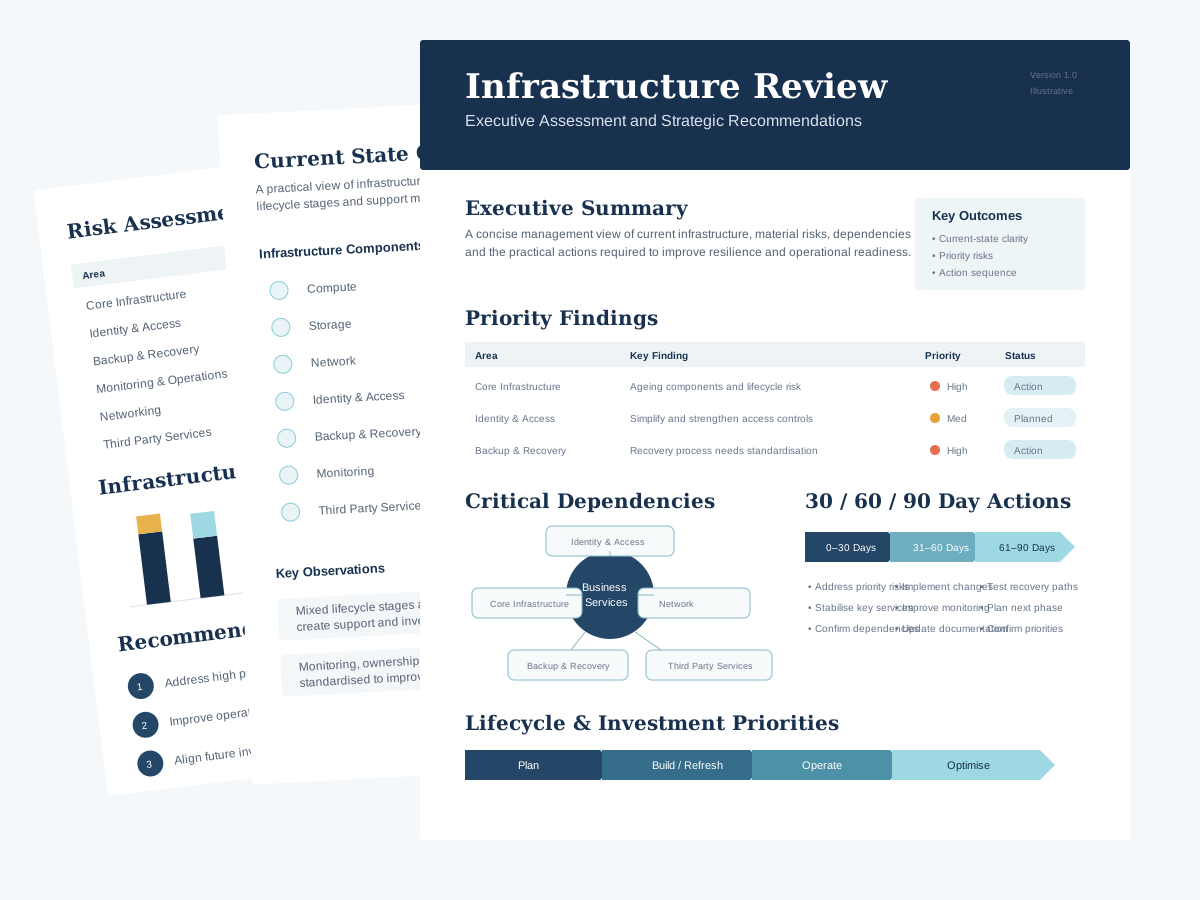
A management-ready view of what matters and what should happen next.
The report turns technical observations into a prioritised decision document covering immediate risks, hidden dependencies, evidence gaps, investment choices and a practical improvement sequence.
- current-state summary
- priority dependency map
- infrastructure risk snapshot
- backup and recovery observations
- documentation gap analysis
- monitoring and visibility observations
- vendor and ownership notes
- lifecycle and capacity concerns
- prioritised action list
- recommended next engagement path
Useful before growth, change or recurring support.
The review is most valuable before the organisation commits money, accepts a new obligation or carries an unclear operating model into the next phase of growth.
Before buying equipment
Understand the problem, dependencies and current constraints before a product decision becomes the architecture.
Before changing providers or support models
Establish what needs ownership, monitoring, documentation and recurring senior technical attention.
Before procurement or due diligence
Improve the evidence available when larger clients, insurers, boards or procurement teams ask harder questions.
After years of organic growth
Untangle an environment that has expanded faster than standards, documentation and technical ownership.
Questions organisations ask before reviewing an infrastructure environment.
An Infrastructure Review is a senior-led assessment of how an organisation's networks, systems, storage, backup, access, monitoring, documentation and vendor dependencies work together. The purpose is to identify material risk, hidden dependencies and the practical next actions before larger decisions are made.
It creates a shared evidence base before the organisation commits to a project, changes supplier, purchases equipment or adopts ongoing support. That reduces the risk of solving the wrong problem or carrying hidden dependencies into the next stage.
A useful review should cover the systems that support important business services, their dependencies, current visibility, backup and recovery evidence, documentation quality, technical ownership, vendor boundaries, lifecycle risk and the way incidents are handled today.
A review is designed to improve decisions and operations. An audit tests evidence against a formal standard, control set or regulatory requirement. Revelate Systems can identify gaps and prepare the environment for deeper assurance work, but the Infrastructure Review itself is not a certification.
The strongest timing is before a major purchase, site move, cloud or network change, new managed-service arrangement, procurement process or period of rapid growth. It is also useful when outages repeat, documentation is weak or nobody has a complete view of the environment.
Yes. Hidden dependencies are often the most valuable finding. A shared storage platform may depend on switching, identity, DNS, licensing, remote access, power and a vendor support path. The Revelate Dependency Test connects the business service to the systems, dependencies, owners and recovery path behind it.
Useful evidence includes network diagrams, asset lists, configurations, backup reports, monitoring dashboards, vendor contracts, access records, incident history, lifecycle information and conversations with the people who operate the environment. Missing evidence is itself an important finding.
The duration depends on the number of sites, systems, vendors and the quality of existing documentation. A focused small environment may be reviewed quickly, while a multi-site or operationally sensitive environment requires deeper evidence gathering and stakeholder interviews.
The report should explain the current environment in management-ready language, identify the highest-impact risks and dependencies, distinguish urgent work from longer-term improvement and provide a prioritised action plan rather than an undifferentiated list of technical observations.
Yes, and that is often the best time to do it. Reviewing the current environment first reduces the risk of buying a product that treats a symptom, creates a new dependency or locks the organisation into an unsuitable design.
Yes. The findings can lead into a defined remediation project, Infrastructure Design and Delivery, Supplier Readiness work or Managed Infrastructure Care where recurring ownership and improvement would be valuable.
Start with a clear view of your current environment.
A short conversation is enough to determine whether an Infrastructure Review is the right first step before a larger project, supplier change or ongoing care arrangement.
Discuss an Infrastructure Review